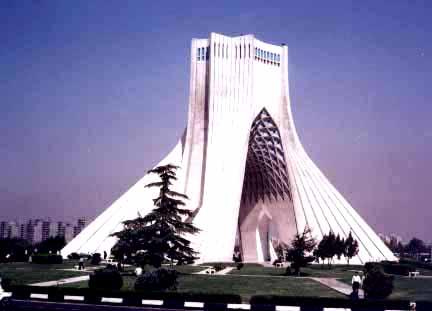
Tehran or Teheran, capital and largest
city of Iran, in the northern part of the country, on a sandy plateau,
about 1173 m (about 3850 ft) above sea level. Tehran is also the capital
of Tehran Province. Local industries produce processed food, cotton textiles,
cement, and bricks. The huge crude-oil industry, although centered in Abadan
and other areas, is administered by the National Iranian Oil Company in
Tehran. To the north of the city, in the foothills of the Elburz Mountains
( Elburz Mountains, mountain range, northern Iran, extending along the
southern shore of the Caspian Sea. The range marks the northern limit of
the Iranian Plateau. The Elburz have an average altitude of about 1524
m (about 5000 ft). The highest peak in the system, Mount Damavand, is 5601
m (18,376 ft) above sea level.), is the Shemìranat residential district.
Most of the recent rapid growth of Tehran has been to the north, where
new residential sections now link it with Shemìranat. To the south
are the factories and the older sections, including remnants of a large
bazaar that has been largely replaced by shops. Farther south are Aliabad,
the burial site of the Ayatollah Ruhollah Khomeini, and the ruins of the
ancient cities of Rhages, birthplace of the caliph Harun ar-Rashid, and
Rayy, where an oil refinery now stands. At the center of Tehran are Sepah
and Ferdowsì squares, on or near which are the important government
buildings and several mosques and palaces. To the south of Sepah Square
is the Golestan Palace Museum, containing celebrated Persian treasures.
Also notable is the Iran Bastan Museum, containing artifacts from ancient
Persian sites. Among educational facilities in the city are the University
of Tehran (1932) and Shahid Beheshti University (1959).
When the ancient city of Rayy was destroyed by the Mongols in 1220, Tehran, a small suburb dating possibly from the 4th century AD, survived; it grew slowly in succeeding centuries. The city contained a walled bazaar and some 3000 houses early in the 17th century. Agha Mohammad Khan, founder of the Kajar dynasty, made Tehran the capital of Persia in 1788.
Under the Pahlavi dynasty (1925-1979),
Tehran was modernized, industrialized, and considerably rebuilt. While
several mosques and palaces of the 19th century remain, most of the architecture
is new. Among recent additions to the city are the Senate building, the
Marble Palace, the opera house, a stadium capable of seating some 100,000
spectators, and two international airports. In 1943 the city was the site
of the Tehran Conference of Allied leaders. The city experienced considerable
turmoil following the overthrow of the Pahlavi dynasty in 1979. More than
50 United States citizens were held hostage by Iranians in the American
embassy in Tehran from November 1979 until January 1981. Population (1986)
6,042,584.
Big Three, Tehran, Iran
Soviet leader Joseph Stalin, United States president Franklin D. Roosevelt,
and British prime minister Winston Churchill, seated left to right, met
in Tehran, Iran, in 1943 to discuss their military strategy and post-World
War II policy for Europe. The leaders decided to invade France in 1944,
against Churchill's recommendations. The meeting marked the apex of the
East-West wartime alliance. Stalin, Roosevelt, and Churchill, the leaders
of the three major Allied powers, came to be known as the "Big Three."