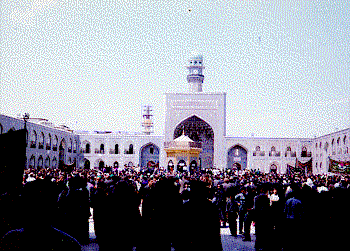
Meshed, also Mashad, city in northeastern Iran, capital
of Khorasan Province in the Kashaf Rud Valley, near Turkmenistan and Afghanistan.
One of the largest cities in Iran, it is an important transportation, commercial,
manufacturing, and religious center situated in a productive agricultural
region. Carpet manufacturing, based on local wool supplies, is a traditional
industry; other products include textiles, chemicals, pharmaceuticals,
and processed food. The burial place and shrine of the early 9th-century
religious leader Ali ar-Rida, regarded by Shiite Muslims as one of Iran's
holiest places, draws many tourists and pilgrims every year. The grave
of the caliph Harun ar-Rashid is also in the shrine. Meshed University
(1956) was established here, and the ruins of the ancient city of Tus are
nearby.
Meshed gained prominence as a religious center in the 9th century.
Shah Abbas I (reigned 1588-1629) beautified the city, and it prospered
under Nadir Shah as the capital of a great Iranian empire. Population (1986)
1,463,508.
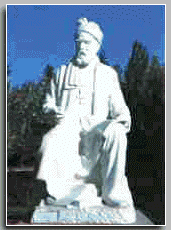 Ferdowsi
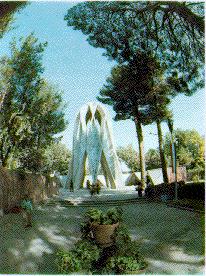 Khayam.
Attar-e Neyshaburi Farid Od-din Attar Neyshaburi
was one of the greatest muslim mystical
poets and thinkers of the 12th century. He has written at least 45,000
distichs (couplets) and many
brilliant prose works.
Attar travelled extensively, visiting egypt, syria, arabia, india and
central asia and finally settled in his
native town neishabour, northeastern iran, where he spent many years
collecting the verses and
sayings of famous muslim mystics.
The greatest of his works is his well-known 'manteq ot-teyr' (the conference
of the birds), which is an
allegorical poem describing the quest of the birds. his other works
include 'elahinameh' (divine book).
From the point of view of ideas, literary themes and style, attar's
influence was strongly felt not in
persian literature but in other islamic literatures.
His grand book of Tazakor-ol-Oliah is in prose and his most famous works
in verse include:
Asrarnameh, Elahinameh, Mosibatnameh, Manteq-u'ttair, Bulbulnameh,
Heydarnameh, Mokhtarnameh
and Khosrownameh among which Mantegh-u'ttair is unrivaled in mastery
and composition.
Manteq-u-ttair or the Conference of Birds, sung in iambic hexameter,
is an elegantly versified book.
Following Solomon's tradition the poet puts tongue in the mouths of
the birds and enables them to
warble his theme and fly high and high towards Mount Ghaf in search
of the invincible Simorgh or
Phoenix which he ascribes to the Almighty God, and by this metaphor
Attar brings his episode to a
surprising climax. Led by the unwavering hoopoe or Hod Hod, thirty
birds out of many thousands
manage to cross the seven fatal valleys in the Path and arrive at the
majestic court of the Prince of
Universe on the verge of annihilation.
What they see in amazement there is an enormous phantom mirror of a
thousand molten planets which
reflects their own shapes and purified selfs. Here they dissolve in
the mirror and join the enternity.
The poet opens the conference by praising hoopoe, Solomon's herald and
other chosen birds each
representing a mystic metaphor: Hail to you, oh hoopoe, our nimble
guide, A messenger that at ev'ry
bower fly and glide, Bid by King Solomon to far Sheba you were gone
(Solomon to whom the language
of birds was known); You hold Solomon's diadem on your head, And converted
the Queen of Sheba to
his faith.